Skip to content

Home/The Programme

One academic year

Ten modules that build on one another

The year is sequenced deliberately. Foundations come first, the biblical corpus second, doctrine third, and the practical disciplines of evangelism and teaching run alongside throughout — because a student should be putting the work to use from the first term, not the last.

10
Modules
60
Credits to the award
2
Hours each Thursday
4
Chapel services

Course catalogue

What you will study

Filter by strand to see how the year is built. Every course is taught live; none of it is a video library you work through alone.

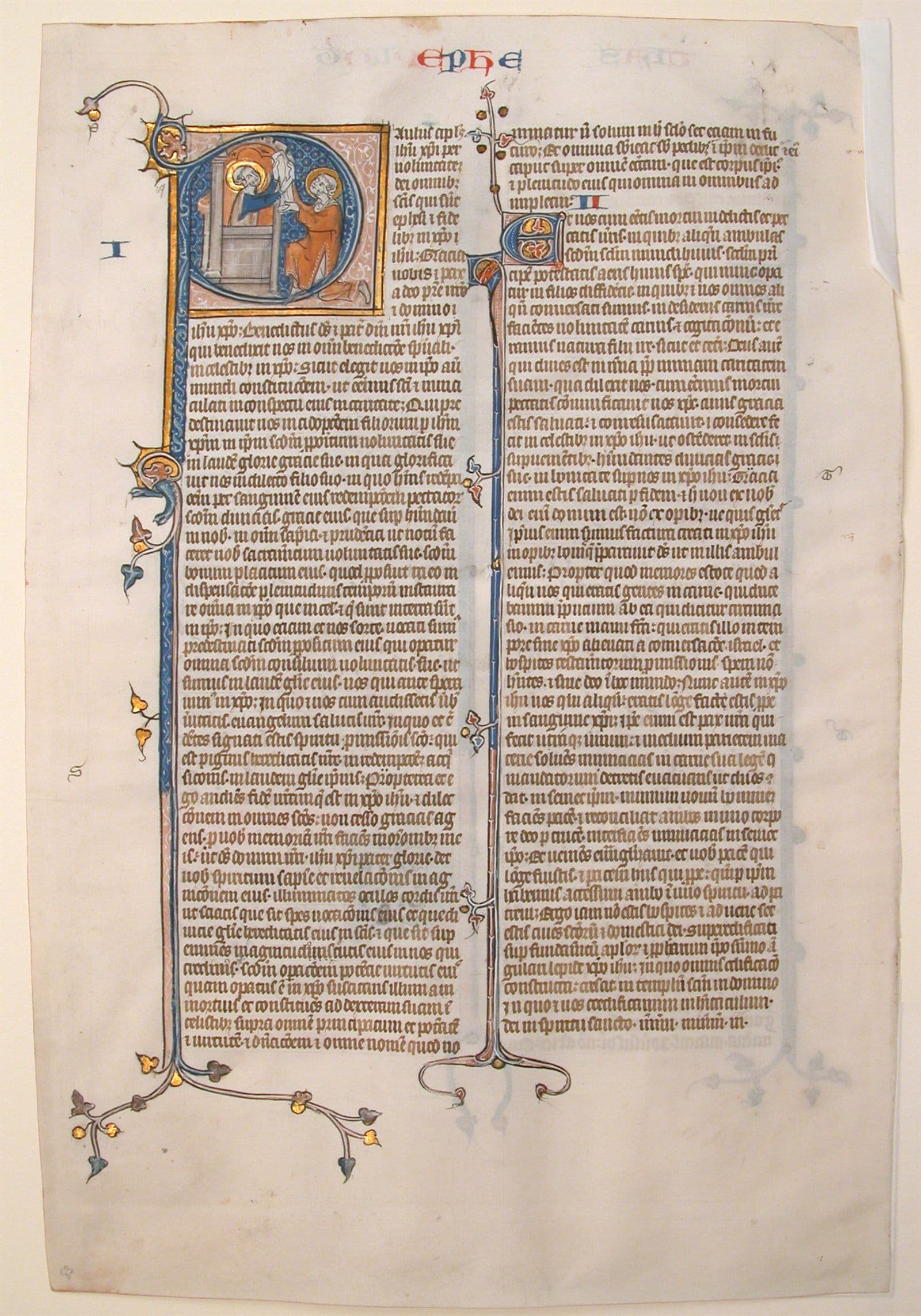
Illuminated manuscript leaf opening Saint Paul's Epistle to the Ephesians, with a decorated initial in gold and colour.
Manuscript leaf opening the Epistle of Saint Paul to the Ephesians · ca. 1300The Met, Open Access (CC0)

10 courses · 65 credits

  • I

    Bible Fundamentals I & II

    The theological and spiritual foundations on which all later ministry and study are built: salvation, repentance, effective prayer, the ministry of Christ, the power of His blood, the Resurrection, baptism, the work of the Holy Spirit, and the marks of the authentic believer.

    Syllabus · 22 topics +
    1. 01
      Introduction
    2. 02
      What does it mean to be a believer?
    3. 03
      What is discipleship?
    4. 04
      What is faith?
    5. 05
      Bible basics
      • What does it communicate?
      • Where is my place?
    6. 06
      What is salvation, and how does it affect me?
    7. 07
      What is repentance?
      • Why is it important?
    8. 08
      Effective prayer
    9. 09
      The ministry of Christ
      • His miracles
      • His message
      • The parables — the spiritual truths revealed
    10. 10
      The Beatitudes
    11. 11
      Christ's sacrifice — “The Power of His Blood”: the Passover and Christ's Passion
    12. 12
      The power and importance of the Resurrection
    13. 13
      Baptism, the gateway sacrament — “The death of the flesh, the awakening of the Spirit”
    14. 14
      The first converted Christian
    15. 15
      The work of the Church in the life of the believer
      • The Church's responsibility to the believer
      • The believer's responsibility to the Church
    16. 16
      The work of the Holy Spirit — who is He?
    17. 17
      The process of sanctification
    18. 18
      Old Testament law and New Testament grace
    19. 19
      Christian church denominations
    20. 20
      Comparative religions (overview)
    21. 21
      Heaven and hell
    22. 22
      Signs of the believer
      • The evidences of salvation
      • Living with liberty under control
      • Grace with responsibility

    Set texts · The Bible & Foundational Truths for Christian Living · The Spirit-Filled Believer — Derek Prince

    8 credits

  • II

    Introduction to Christian Ethics

    Moral reasoning grounded in the teaching of Christ. Students learn to separate the primary questions of ethics — source, human nature, purpose — from specific moral dilemmas, and to apply biblical values to contemporary life through the lens of Micah 6:8.

    Syllabus · 6 topics +
    1. 01
      Part 1 — Foundations of Christian ethics
      • Christian ethics defined
      • Primary questions: the source of Christian ethics, the nature of human beings, the purpose of Christian ethics
      • Secondary questions: responding to moral dilemmas, the principles and virtues Christian ethics emphasises, the role of the Christian community
      • Pagan and Christian ethics compared
      • The Christian view of goodness
    2. 02
      Part 2 — Living out Christian ethics (Micah 6:8)
      • The importance of our study
      • Christian ethics challenged by life
      • The influence of radio, television and literature
      • The lofty ideals of the Christian faith (Ephesians 1:13; 4:4)
      • The mighty agencies that make these ideals possible
      • Perfection as an ideal, and what it implies
      • The believer's progressive intimacy
      • Christian character in manifestation
      • Love, the greatest of ideals
    3. 03
      Part 3 — Believers in the heavenly kingdom
      • The believer in the heavenlies
      • Separation in Scripture
      • Three classes of men
      • Believers as a kingdom of priests
      • Justification and sanctification
      • The doctrine of regeneration (John 3:3–8): its nature, necessity and means
      • Personal divine life — prayer (James 5:7)
      • Old and New Testament views of prayer; David's penitential prayer
      • Christ's high-priestly prayer: three broad petitions
      • The conditions of right prayer
    4. 04
      Personal divine life — service
      • Service, the object of personal life
      • Profound lessons in the call of Moses
      • Other prominent lessons of service
      • The range of Christ's service
      • Service in contrast
    5. 05
      Personal divine life — fellowship and worship
      • Stages of experience
      • The peace offering and fellowship
      • The expression of fellowship and worship
      • The Christian's means of fellowship and worship
    6. 06
      Union with God and the fullness of the Spirit
      • Union with God, the goal of personal divine life
      • Union with God among the prophets
      • Israel's further longing for divine union
      • The Christian era: abiding in Christ
      • Spirit-filling, a complete assurance

    Set texts · Christian Ethics: An Introduction to Biblical Moral Reasoning — Wayne Grudem · Christian Ethics in Plain Language — Kerby Anderson

    6 credits

  • III

    Evangelism

    Training in effective Gospel witness: the history of evangelism from Acts through the modern revivals, the character of the evangelist, the work of the Holy Spirit in evangelistic ministry, and practical preparation in public speaking and homiletics.

    Syllabus · 7 topics +
    1. 01
      What is an evangelist?
      • Their importance
      • Their role and purpose in the wider Christian community
    2. 02
      The history of evangelism
      • The Bible's references — the Book of Acts
      • Evangelism after the persecutions
      • The revival periods of the modern Church
    3. 03
      Character studies: noted evangelists
      • Biblical
      • Modern
    4. 04
      The work of the Holy Spirit in relation to the evangelist
    5. 05
      Effective communication — the message of Good News
      • Written
      • Oral
    6. 06
      The elements of the Gospel message
    7. 07
      Preparing to be an evangelist
      • The criteria
      • Public speaking and preaching: oral presentation and homiletics

    Set texts · Evangelism in the Early Church — Michael Green · Tell the Truth — Will Metzger

    8 credits

  • IV

    Introduction to Systematic Theology

    A survey of the ten fundamental doctrines of the Church — Theology, Christology, Pneumatology, Soteriology, Hamartiology, Bibliology, Anthropology, Ecclesiology, Angelology and Eschatology — assembled into a coherent framework a student can reason from.

    Syllabus · 9 topics +
    1. 01
      Introduction
      • What is systematic theology?
      • What purpose do the doctrines serve within the Church?
      • An overview of the ecumenical councils
      • Denominational views on systematic theology
    2. 02
      The doctrines — the Trinity
      • Theology
      • Christology
      • Pneumatology
    3. 03
      Soteriology — salvation
    4. 04
      Hamartiology — sin
    5. 05
      Bibliology — the Bible
    6. 06
      Anthropology — humanity
    7. 07
      Ecclesiology — the Church
    8. 08
      Angelology — angels
    9. 09
      Eschatology — last things

    Set texts · The Great Doctrines of the Bible — William Evans

    6 credits

  • V

    General Bible I & II

    The whole Book: its components, its eight dispensations, its eight covenants, and the Tabernacle in the wilderness — history, poetry and prophecy traced end to end. Prerequisite: Bible Fundamentals or equivalent.

    Syllabus · 7 topics +
    1. 01
      Introduction
      • What is the Bible?
      • To whom and for whom it was written
      • A brief history of how it came to its present form
      • The languages of the Bible
      • The geography and culture of the Bible
    2. 02
      The books of history
      • The Pentateuch: creation, the Garden of Eden and the Fall, the Flood, the lives of the patriarchs
      • Abraham, Moses, Joshua, Caleb and the Judges
      • Ruth, Samuel, Kings, Ezra, Nehemiah and Esther
    3. 03
      The books of poetry
      • Job, Psalms, Proverbs, Ecclesiastes, Song of Solomon
    4. 04
      The books of prophecy
      • Major prophets: Isaiah, Jeremiah, Ezekiel, Daniel
      • Minor prophets: Hosea to Malachi
      • Prophecies to Israel, Judah, the Gentile nations, Assyria and Chaldea; exilic and post-exilic prophecy
    5. 05
      The covenants of the Bible
      • Edenic, Adamic, Noahic, Abrahamic, Mosaic, Davidic, Palestinian, and the New Covenant
    6. 06
      The Tabernacle — worship in the wilderness
      • Composition and layout
      • The vessels of the Tabernacle
      • The High Priest and the priests' vestments
      • The feasts established within Israel
    7. 07
      The dispensations of the Bible
      • Innocence, Conscience, Human Government, Promise, Law, Grace, Tribulation, Kingdom

    Set texts · Journey Through the Old Testament — Harcourt Religion Publishers · 1001 Surprising Things You Should Know About the Bible — MacGregor & Prys

    8 credits

  • VI

    The Gospels

    A historical, biographical and exegetical study of the life and teaching of Jesus across the four Gospels — their origin, transmission and distinct emphases, with particular attention to the final six months of His earthly ministry.

    Syllabus · 6 topics +
    1. 01
      Introduction to the Gospels
      • Why the Gospels were written
      • The Gospel today and the first-century Gospel
    2. 02
      The origin, development and transmission of the Gospels
    3. 03
      The Gospel according to Mark
      • The meaning of “Christ” and “Messiah”
      • The “Messianic secret”
      • The secret of the Kingdom of God
      • Those who recognise the Christ
    4. 04
      The Gospel according to Matthew
      • Matthew and Mark's similarities
      • Old Testament quotations
      • Jesus fulfils the law
    5. 05
      The Gospel according to Luke
      • Angels address Mary in Luke, Joseph in Matthew
      • Matthew's and Luke's genealogies compared
      • The uniqueness and view of Luke
    6. 06
      The Gospel according to John
      • Christology
      • Jesus is God
      • Jesus' commandments to the disciples
      • How belief and love relate

    Set texts · Four Portraits, One Jesus · Synopsis Quattuor Evangeliorum — Greek–English RSV

    6 credits

  • VII

    The Life of Paul

    The apostle called out of due time: his background and training, Stephen's stoning as unconscious preparation, the Damascus road, the missionary journeys, the great controversy of Acts 15, and the message of the epistles.

    Syllabus · 8 topics +
    1. 01
      Background
      • Time of birth
      • The state of the world
      • Family
      • Education
      • Employment and trade
    2. 02
      Early religious involvement
      • Stephen's preaching and stoning — unconscious preparation for ministry
      • Saul's early persecution of the Church
      • The Damascus experience and conversion
    3. 03
      The work suited to his talents and ability
    4. 04
      Character study: his written works, his character
    5. 05
      The missionary journeys
    6. 06
      The church community shaped by Paul
      • The great controversy — Acts 15
      • His Gospel — Romans
    7. 07
      Paul's place in history
    8. 08
      The message of the epistles (overview)
      • 1 & 2 Corinthians, Galatians, Ephesians, Philippians, Colossians, 1 & 2 Thessalonians, 1 & 2 Timothy, Titus, Philemon, Hebrews

    Set texts · The Life of St. Paul — James Stalker

    6 credits

  • VIII

    Introduction to the Book of Revelation

    An introductory overview of Revelation — its symbolism unravelled and set against Daniel's visions: the Nicolaitans, the horsemen, the seven judgments of seals, bowls and trumpets, and the Olivet discourses.

    Syllabus · 13 topics +
    1. 01
      Introduction
    2. 02
      The Nicolaitans
    3. 03
      The Book of Daniel and his visions
    4. 04
      The horsemen of the Apocalypse
    5. 05
      The seven judgments — seals, trumpets and bowls
    6. 06
      The Olivet Discourse
    7. 07
      The horsemen in time
    8. 08
      The Book of Revelation
    9. 09
      Eschatology
    10. 10
      Key words: judgment, hell, predestination, death
    11. 11
      The prophets: present, future, last things
    12. 12
      The regathering and restoration of Israel
    13. 13
      Zechariah — worldwide impact

    Set texts · The Book of Revelation — Clarence Larkin · The Companion Bible — E. W. Bullinger

    3 credits

  • IX

    African Presence in the BibleSignature

    The presence of persons of colour throughout biblical antiquity, their contributions and their lasting monuments. Nine lessons from the geography of Eden through the sons of Ham — Cush, Mizraim, Phut and Canaan — to the genealogy of Christ and the women of colour in biblical history. Full outline →

    Syllabus · 9 topics +
    1. 01
      Lesson 1 — Introduction and theory
      • Approaches to the sources
      • Defining “Africanness”
      • The Bible's explicit, implicit and presumed African presence
    2. 02
      Lesson 2 — Identifying African people in the Bible
      • Names and adjectives
      • Ancestors and family trees
      • The importance of this study
      • Anthropologist, archaeologist and artefact defined
    3. 03
      Lesson 3 — In the beginning
      • The Garden of Eden and its geographical boundaries
      • Adam, and the patriarchs before and after the Flood
      • Mesopotamia and early civilisation: agriculture, the ziggurat, irrigation, cuneiform and the scribe
    4. 04
      Lesson 4 — Noah and his sons
      • The curse explained (Genesis 9:20–27)
      • Hamitic, Japhetic and Semitic
      • The uses of the word Ham
      • The sons of Ham — Cush (Ethiopia) and his descendants
    5. 05
      Lesson 5 — Mizraim (Egypt)
      • The sons and descendants of Mizraim
      • The story of Joseph and ancient Egypt
    6. 06
      Lesson 6 — Phut (Libya)
      • The Libyans and the Cyrenians — Simon of Cyrene, Lucius of Cyrene
    7. 07
      Lesson 7 — Canaan
      • The sons of Canaan and the Canaanite peoples
      • Descendants of Canaan in Scripture
    8. 08
      Lesson 8 — The genealogy of Yeshua (Jesus) Christ
    9. 09
      Lesson 9 — Women of colour who left their mark on biblical history

    Set texts · The Original African Heritage Study Bible, KJV — General Editor Rev. Cain Hope Felder

    6 credits

  • X

    Teachers Training I & II

    Equipping the student to teach: the philosophy and history of Christian education, the three vehicles of home, school and church, developmental stages from infancy to adolescence, comparative religions, and the craft of the lesson plan itself.

    Syllabus · 15 topics +
    1. 01
      Introduction
    2. 02
      The philosophy of Christian education
    3. 03
      The philosophy of religion
    4. 04
      The history of education in relation to Christian theology
      • The Jewish, Athenian, Spartan and Roman communities
    5. 05
      Christianity, pagan culture and teaching
      • Rejection, resistance, reconciliation, and its results
    6. 06
      Three vehicles of Christian education
      • Home, school, church
    7. 07
      Three influences on Christian education
      • Heredity, environment, personality
    8. 08
      Early childhood education
      • From infancy (0–6) to middle adolescence (15–17)
    9. 09
      The Sunday School ministry
    10. 10
      Comparative religions
      • Hinduism, Buddhism, Confucianism, Judaism, Islam
    11. 11
      Cultic religions
      • Jehovah's Witnesses, the Unification Church, the Latter-day Saints, Scientology
    12. 12
      The sociology of education
    13. 13
      Being effective as an educator
    14. 14
      The goals and objectives of the educator
    15. 15
      Exit protocols: preparing and delivering a lesson plan

    Set texts · The Craft of Christian Teaching: Essentials for Becoming a Very Good Teacher — Israel Galindo

    8 credits

The award

On completing 60 credits, with tuition settled and attendance in good standing, the student is eligible to receive the Associate Degree in Theology.

Assessment

How the work is measured

Two formal examinations, with structured revision in the weeks before. Teaching courses are additionally assessed by teaching — you will stand up and deliver, and you will be given honest feedback on what worked.

Examination dates

Mid-term and final examination dates are published to students in advance, in the timetable in their student portal, with revision weeks before each.

Programme structure by component and hours
ComponentFormatWhen
Commencement — first classLive on Google Meet, 7–9pm UKThursday 8 October 2026
Weekly instructionLive on Google Meet, Thursdays 7–9pm UK time · questions and answers 8:45–9pm · the link comes by email or the class group chatEvery Thursday →
Christmas vacationNo classes16 December 2026 – 7 January 2027
Holy WeekNo classes19 March – 1 April 2027
Online Chapel ServiceLive, after every three modulesQuarterly
Academic year concludes—September 2027
GraduationGowns are paid for separately, before the ceremonySeptember 2027

Dates as published in the 2026–27 catalogue, subject to final confirmation by the Office of the Registrar.

Ready to begin?

Applications for the coming cohort are open. The form takes about ten minutes.